
It depends on your needs, but dental implants are generally considered the better long-term solution, while dental bridges are often the better short-term or budget-friendly option. Implants last longer, protect your jawbone, and don’t affect nearby teeth, whereas bridges are quicker, less invasive, and more affordable upfront.
What Is a Dental Bridge?
A dental bridge is a fixed dental solution used to replace a missing tooth. It “bridges” the gap by placing an artificial tooth (called a pontic) between two supporting teeth. These supporting teeth, known as abutment teeth, are covered with crowns that hold the bridge securely in place. Once placed, the bridge stays in your mouth and works like a natural tooth.
To place a bridge, your dentist reshapes the nearby teeth so the crowns can fit properly. Then, impressions are taken to create a custom bridge, which is placed during a follow-up visit. The whole process usually takes a few appointments and does not require surgery. Dentists often recommend bridges if you want a quicker solution, cannot get implants, or if the nearby teeth already need crowns.
What Is a Dental Implant?
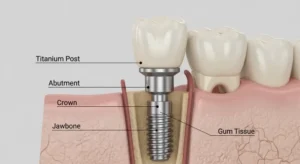
A dental implant is a modern solution that replaces a missing tooth completely, including the root. It has three main parts: a titanium post placed in the jawbone, an abutment that connects the post, and a custom crown that looks like a natural tooth.
The implant becomes strong and stable because the post bonds with your jawbone over time. This process helps it feel and function like a real tooth. However, it takes longer than a dental bridge because healing is needed after the surgery. The full process can take a few months, and it works best for patients with good bone health and overall oral condition.
Quick Comparison: Bridges vs Implants at a Glance
| Factor | Dental Bridge | Dental Implant |
| Procedure type | Non-surgical | Surgical |
| Average cost (per tooth) | Lower upfront cost | Higher upfront cost |
| Lifespan | 10–15 years | 20+ years / lifetime |
| Healing time | 2–3 weeks | 3–6 months |
| Affects adjacent teeth? | Yes reshaping required | No |
| Preserves jawbone? | No | Yes |
| Maintenance | Special flossing tools needed | Brush and floss normally |
| Bone density required? | No | Yes (or grafting needed) |
The Detailed Breakdown: Seven Key Differences
Understanding the key differences between dental bridges and implants helps you make a more confident decision. Each option has its own advantages depending on your needs, budget, and long-term goals.
Cost Upfront vs. Long-Term Investment
Dental bridges usually cost less at the start, which makes them a more budget-friendly option for many patients. Implants, on the other hand, have a higher upfront cost because they involve more steps, including surgery and multiple components.
However, when you look at the long term, implants can be a better investment. Bridges may need to be replaced after several years, while implants can last much longer with proper care. Over time, this can make implants more cost-effective, especially for patients looking for a long-lasting solution.
Longevity and Durability
Dental bridges are strong and reliable, but they don’t last forever. With good care, most bridges last around 10 to 15 years before they may need repair or replacement. Over time, wear and tear, weakening cement, or decay under the crowns can affect their lifespan.
Dental implants, however, are built to last much longer. Once the implant fuses with the jawbone, it becomes a stable and permanent part of your mouth. Many implants last 20 years or more, and in some cases, a lifetime. While the crown on top may need replacement over time, the implant itself is designed for long-term durability.
Procedure and Healing Time
If you want a quick solution, dental bridges are the better option. The process usually takes a few appointments over a few weeks, and there is no surgery involved. Most patients can return to normal eating fairly quickly after the bridge is placed.
Dental implants take more time and patience. After the implant is placed, the jawbone needs a few months to heal and bond with the post before the final crown is added. In some cases, the process can take even longer if additional procedures are needed. This longer timeline is one of the main reasons some patients choose bridges instead.
Impact on Adjacent Teeth
One major difference between bridges and implants is how they affect nearby teeth. To place a dental bridge, the dentist must reshape the healthy teeth on both sides of the gap so they can support crowns. This means those natural teeth are permanently altered and will always need protection.
Dental implants do not affect surrounding teeth at all. They are placed directly into the jawbone and work independently. For patients with healthy nearby teeth, this makes implants a better option because they help preserve natural tooth structure.
Bone Health and Jaw Preservation
When a tooth root is lost, the jawbone beneath it begins to resorb shrinking over time due to lack of stimulation. A dental bridge replaces the visible tooth but does nothing to address this bone loss because it rests on top of the gum rather than integrating with the bone below.
An implant’s titanium post actively stimulates the jawbone with every bite, preventing the bone resorption that otherwise occurs. Over the long term, this has meaningful consequences for facial structure, the stability of surrounding teeth, and your candidacy for future dental work. This is arguably the most significant functional advantage implants hold over bridges.
Maintenance and Cleaning
Bridges require dedicated cleaning under the pontic, where food debris and bacteria can accumulate between the bridge and the gum. Standard floss can’t pass between the teeth, so patients need to use floss threaders, interdental brushes, or a water flosser to maintain hygiene in that area. It’s manageable but it does add steps to your daily routine.
Implants are cleaned exactly like natural teeth: brush twice daily, floss normally, and see your dentist for regular checkups. No special tools required. This simplicity is a genuine quality-of-life advantage, particularly for patients who find specialized cleaning tools inconvenient.
Appearance and Natural Feel

Both dental bridges and implants are made from high-quality materials like porcelain or ceramic, so they look very natural. In most cases, people won’t be able to tell the difference between them and your real teeth.
The main difference is how they feel. Dental implants are placed in the jawbone, so they feel very similar to natural teeth when you bite and chew. Bridges are supported by nearby teeth, so they may feel slightly different at first. Most patients adjust quickly, but implants usually feel more natural over time.
Pros and Cons: Dental Bridges
Pros:
- More affordable upfront cost
- Faster treatment no surgery needed
- Suitable when bone density is low
- Covered by more insurance plans
- Proven, well-established procedure
Cons:
- Shorter lifespan (10–15 years)
- Requires reshaping healthy adjacent teeth
- Does not prevent jawbone loss
- Requires special cleaning tools
- Higher cumulative cost over decades
Pros and Cons: Dental Implants
Pros:
- Long-lasting often 20+ years
- Preserves jawbone and facial structure
- Feels and functions like a natural tooth
- No alteration to adjacent teeth
- Simple maintenance brush and floss normally
Cons:
- Higher initial cost
- Requires sufficient bone density
- Surgical procedure with healing time
- Treatment spans several months
- Not always covered by insurance
Which Option Is Right for You?

The answer comes down to five key factors that your dentist will evaluate and that you should think through before your consultation.
A Bridge May Be Better If:
- Budget is a primary concern right now
- You need a faster solution
- Bone density is insufficient for implants
- Adjacent teeth already need crowns
- You have medical conditions limiting surgery
- Multiple adjacent teeth are missing
An Implant May Be Better If:
- You’re investing in a long-term solution
- Adjacent teeth are healthy and intact
- You have good bone density in the jaw
- Only a single tooth needs replacement
- You want minimal maintenance
- Long-term bone preservation matters to you
Age, lifestyle, and overall health also factor in. Younger patients often benefit more from implants because they have more years ahead to realize the long-term advantages. Older patients or those with certain systemic conditions may find bridges the practical, sensible choice. A smoker may face higher implant failure risk and should discuss this with their dentist. Someone with diabetes will need carefully managed healing protocols for either option.
When Dentists Recommend Bridges vs. Implants
Dentists typically recommend a Bridge when: the patient has insufficient jawbone density for implant placement (or wants to avoid bone grafting), requires a quicker solution for functional or aesthetic reasons, has two or more consecutive missing teeth, or when the adjacent teeth already need restorative work making a bridge a clinically efficient option.
Dentists typically recommend an Implant when: the patient has adequate bone density and good overall health, wants the most durable and natural-feeling long-term solution, is replacing a single tooth with healthy neighbors on each side, or when preserving bone structure and avoiding alteration of adjacent teeth is a clinical priority.
Your dentist will also consider X-rays and a full periodontal assessment before making any recommendation. The best dental professional will walk you through your specific anatomy and help you weigh the tradeoffs honestly.
Common Myths About Bridges and Implants
Myth: “Implants are always the better choice.”
Implants have compelling advantages, but “always better” ignores real-world constraints. For a patient with low bone density, systemic health issues, or an urgent need for tooth replacement, a bridge may be clinically superior in that context. The best choice depends on the individual patient’s full picture, not on which option sounds more advanced.
Myth: “Bridges are outdated technology.”
Dental bridges have been refined over decades and remain a highly effective, evidence-backed treatment. Modern bridges use stronger materials, better bonding cements, and improved designs compared to older versions. They are not a relic, they are a legitimate, widely-used option that millions of patients rely on successfully.
Myth: “Dental implants are extremely painful.”
This is one of the most persistent myths in dentistry, and it isn’t backed by patient experience data. The implant procedure is performed under local anesthesia, and most patients report that the discomfort afterward is comparable to a tooth extraction manageable with over-the-counter pain relief. Most people are surprised by how comfortable the process actually is.
Restore Your Smile with Confidence in Mesa, AZ
If you’re unsure whether a dental bridge or implant is right for you, the best next step is a personalized consultation. At U Smile Family Dentistry, our experienced team takes the time to evaluate your oral health, explain your options clearly, and recommend the solution that fits your needs and goals.
From replacing missing teeth to restoring full function and confidence, we provide advanced, patient-focused care in a comfortable environment. Book your appointment today and take the first step toward a stronger, healthier smile in Mesa, AZ.
Conclusion
Choosing between a dental bridge and a dental implant depends on your personal needs, goals, and oral health condition. Both options are effective and can restore your smile, improve chewing, and help you speak clearly. Bridges are a faster and more affordable solution, while implants offer better long-term durability, bone support, and a more natural feel.
The best choice comes down to what matters most to you whether it’s cost, time, comfort, or long-term value. A consultation with your dentist will help you evaluate your situation and decide which option is the right fit for your smile and lifestyle.
Frequently Asked Questions
Are dental implants safer than bridges?
Both dental implants and bridges are safe when performed by a qualified dentist. Implants involve surgery, so they require good overall health, while bridges are non-surgical and simpler to place.
Do dental bridges look as natural as implants?
Yes, modern dental bridges and implants both look very natural. They are made from materials like porcelain or ceramic that match your natural teeth.
Can a dental bridge be replaced with an implant later?
Yes, in many cases a dental bridge can be replaced with an implant. However, your dentist will need to check your bone health and overall oral condition first.
Which option lasts longer: bridge or implant?
Dental implants generally last longer, often 20 years or more, while bridges usually last around 10 to 15 years with proper care.
Is the dental implant procedure painful?
The procedure is done under local anesthesia, so you won’t feel pain during it. Afterward, mild discomfort is normal, but it is usually manageable and temporary.