
Implant-supported bridges are often considered the best long-term option because they provide strong support, do not require reshaping neighboring teeth, and help preserve the jawbone. However, they require surgery, sufficient bone, a longer treatment process, and a higher initial cost. The best dental bridge is therefore not the same for every patient.
A traditional bridge may be more suitable when one or two teeth are missing and healthy supporting teeth are available on both sides of the gap. A Maryland bridge is commonly considered for a single missing front tooth because it requires less alteration of nearby teeth. Cantilever bridges are reserved for selected cases where support is available on only one side.
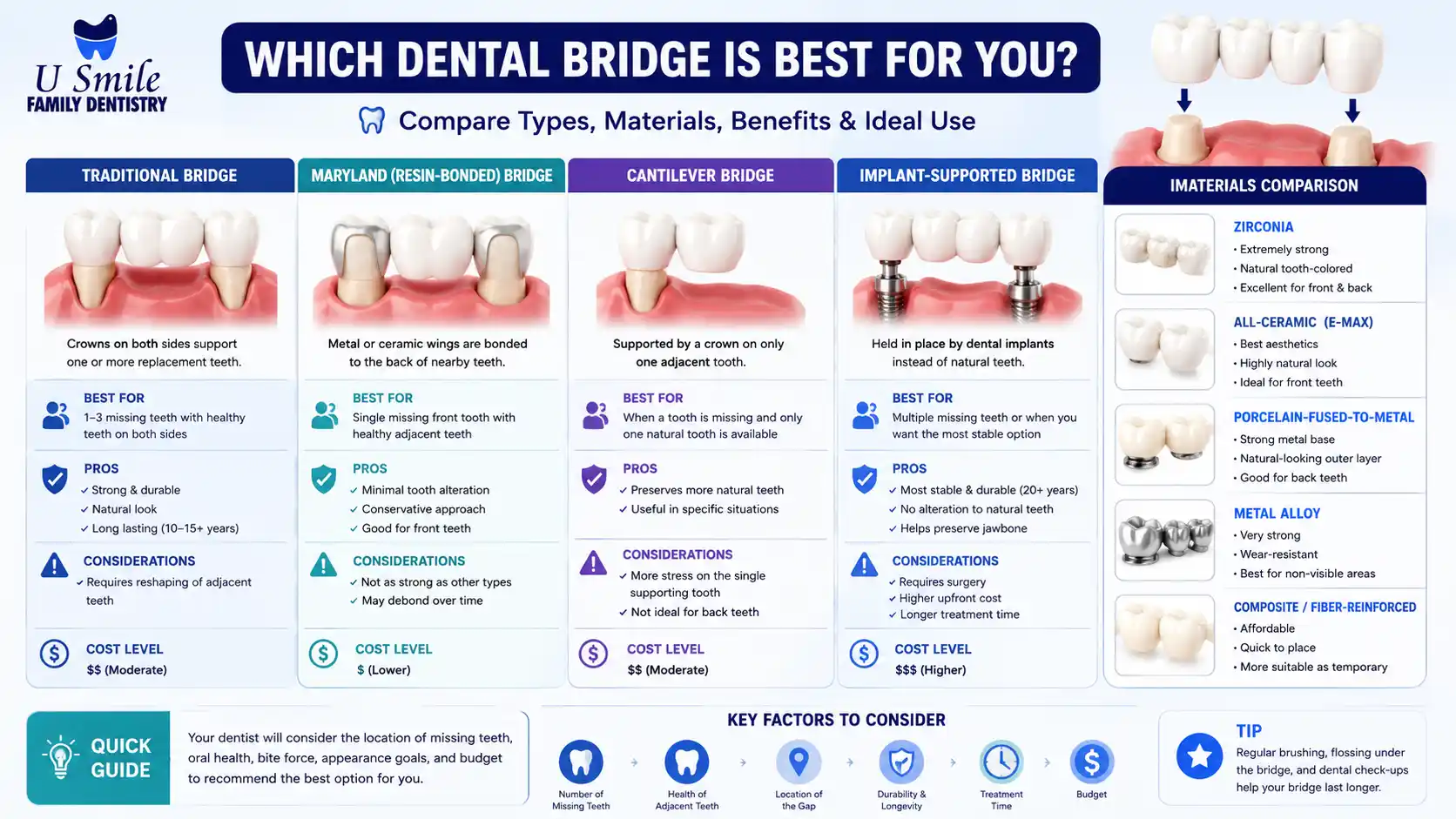
Bridge material also affects strength and appearance. Zirconia is often selected for its durability and tooth-colored appearance, while all-ceramic materials can provide highly natural results for visible front teeth. Metal and porcelain-fused-to-metal bridges may offer dependable strength in areas exposed to heavier chewing forces. This guide compares the main dental bridge types, materials, costs, benefits, and limitations to help you understand which option may best fit your smile.
What Is a Dental Bridge?
A Dental bridges is a fixed dental restoration used to replace one or more missing teeth by literally bridging the gap. It includes one or more artificial teeth, called pontics, that are supported by crowns, bonded wings, or dental implants.
Unlike removable dentures, a dental bridge remains fixed in the mouth. Patients cannot remove it themselves for cleaning or sleeping. Dental bridges are custom-made to match the color, shape, and size of nearby teeth. When properly designed, they can restore chewing function while creating a natural-looking smile.
How Dental Bridges Work
The way a dental bridge works depends on its design. A traditional bridge usually places an artificial tooth between two crowns. These crowns fit over the natural teeth on either side of the gap. The supporting teeth are known as abutment teeth. Before placing the crowns, the dentist removes some enamel from the abutment teeth. This creates enough space for the bridge to fit properly.
A Maryland bridge uses small wings bonded to the backs of nearby teeth instead of full crowns. An implant-supported bridge attaches to implants placed in the jaw rather than relying on natural teeth. After examining the area, the dentist takes physical impressions or a digital scan. A laboratory then creates the custom bridge from materials such as porcelain, ceramic, zirconia, metal alloys, or a combination of materials.
Is a Dental Bridge Permanent?
A dental bridge is considered a permanent or fixed restoration because it is cemented, bonded, or attached to implants and cannot be removed by the patient. However, permanent does not mean it will last forever. A bridge may eventually need repair or replacement because of normal wear, damage, gum disease, decay in the supporting teeth, or changes in the bite.
Traditional bridges often last 10 to 15 years or longer with good care. Implant-supported bridges may last 20 years or more, although the bridge placed over the implants may still require maintenance or eventual replacement. The lifespan of a bridge depends on its material, design, supporting teeth, bite pressure, oral hygiene, and whether the patient grinds or clenches their teeth.
Why People Get Dental Bridges
People choose dental bridges for both practical and cosmetic reasons. The most visible benefit is that a bridge fills the space left by missing teeth. This can restore the appearance of the smile and help patients feel more comfortable when speaking or smiling. Missing teeth can also affect chewing and speech. A properly fitted bridge may help distribute biting pressure more evenly and make it easier to pronounce certain sounds.
Teeth beside an empty space may gradually move out of position. Filling the gap can help maintain better tooth alignment and reduce unwanted changes in the bite. A bridge can also support the lips and cheeks. However, only implant-supported restorations stimulate the jawbone in a way that is similar to natural tooth roots.
Different Types of Dental Bridges
There are four main types of dental bridges: traditional, cantilever, Maryland, and implant-supported bridges. Composite or fiber-reinforced bridges may also be used as temporary or conservative options in selected cases.
The best type depends on:
- The number of missing teeth
- The location of the gap
- The condition of surrounding teeth
- Available jawbone
- Bite pressure
- Appearance goals
- Treatment time
- Budget
Traditional Dental Bridges
A traditional dental bridge is the most common type. It includes one or more artificial teeth supported by crowns placed over natural teeth on both sides of the gap. Traditional bridges work well when suitable teeth are available on each side of the missing tooth. They are often used for back teeth because they can withstand significant chewing pressure. They may also be suitable when the supporting teeth already contain large fillings or need crowns for other reasons.
Pros and Cons
Traditional bridges are strong, stable, and capable of replacing one or more teeth in a row. They can provide natural-looking results and often last 10 to 15 years or longer with proper care.
The main disadvantage is that the dentist must permanently reshape the supporting teeth. Even healthy neighboring teeth may need enamel removed to hold the crowns. If one supporting tooth later develops serious decay, fracture, or gum disease, the entire bridge may be affected.
Cantilever Bridges
A cantilever bridge is similar to a traditional bridge, but it receives support from only one side of the gap. The artificial tooth attaches to a crown placed over a single neighboring tooth. This design may be considered when there is no suitable tooth on the other side.
Cantilever bridges are less common because support from one side creates additional leverage on the abutment tooth. For this reason, they are generally limited to carefully selected areas with lighter biting pressure.
Pros and Cons
A cantilever bridge requires preparation of only one supporting tooth. It may be useful when a traditional bridge cannot be supported from both sides.
However, it places greater stress on the single abutment tooth. This can increase the risk of loosening, fracture, or damage when the bridge is placed in an area exposed to heavy chewing forces. Compared with a traditional bridge, a cantilever bridge generally provides less balanced support.
Maryland Resin-Bonded Bridges
A Maryland bridge, also known as a resin-bonded bridge, uses thin wings bonded to the backs of neighboring teeth. The wings may be made from metal, ceramic, zirconia, or another suitable material. Because the neighboring teeth do not usually need full crowns, this design preserves more natural enamel than a traditional bridge.
Maryland bridges are most commonly considered for a single missing front tooth. The front of the mouth usually receives less chewing pressure than the molar area, making a bonded design more practical.
Pros and Cons
The main advantage of a Maryland bridge is that it requires little alteration of neighboring teeth. Treatment may also be less invasive and completed more quickly than an implant-supported restoration.
However, Maryland bridges are not as strong as traditional or implant-supported bridges. The bonded wings can loosen or debond, particularly when the bite places excessive pressure on the artificial tooth. They are generally not recommended for replacing several missing teeth or for molars that handle strong chewing forces.
Maryland Bridge vs. Traditional Bridge
A Maryland bridge is bonded to the backs of neighboring teeth and usually preserves most of their natural structure. A traditional bridge uses full crowns and requires more enamel removal.
Traditional bridges generally provide greater strength and may be more suitable for back teeth. Maryland bridges are usually considered for a single front tooth when the adjacent teeth are healthy and preserving enamel is important.
Implant-Supported Bridges
An implant-supported bridge attaches to dental implants placed in the jawbone. Instead of placing crowns over natural teeth, the dentist or oral surgeon places implants that act as artificial tooth roots. The bridge is then attached to these implants after the surrounding bone has healed.
Implant-supported bridges are often used when several teeth are missing in a row. In some cases, two implants can support a bridge that replaces three or more teeth.
Pros and Cons
Implant-supported bridges offer strong support and do not require reshaping healthy adjacent teeth. They can also stimulate the jawbone and reduce the bone loss that commonly follows tooth loss. They often feel stable and can last many years with proper care. For suitable patients, they may provide the closest function to natural teeth.
The main disadvantages are the higher initial cost, need for surgery, and longer treatment timeline. Healing and integration of the implants may take several months. Patients also need healthy gums and enough bone to support the implants. Bone grafting may be required when bone volume is insufficient.
Composite and Fiber-Reinforced Bridges
Composite bridges are made from tooth-colored resin, sometimes strengthened with reinforcing fibers. A dentist may create some composite bridges directly in the mouth, which can reduce treatment time and laboratory costs. They usually require less alteration of neighboring teeth than a traditional bridge.
Composite and fiber-reinforced bridges are commonly considered temporary, transitional, or medium-term restorations rather than the strongest permanent option.
Pros and Cons
These bridges can often be placed quickly and may be repaired more easily than porcelain or ceramic restorations. However, composite resin is more likely to stain, wear, chip, or fracture. It does not usually provide the same durability as zirconia, metal, porcelain-fused-to-metal, or implant-supported restorations.
Plastic or acrylic bridges are also commonly used as temporary restorations while a permanent bridge is being created. They protect prepared teeth and maintain appearance but are not normally selected as a long-term solution for heavy chewing areas.
What Is the Best Material for a Dental Bridge?
Zirconia is often one of the best dental bridge materials when both strength and a natural appearance are important. It is tooth-colored, metal-free, and resistant to fracture, making it useful for many front and back teeth.
All-ceramic materials may provide excellent color matching and translucency for visible front teeth. Porcelain-fused-to-metal bridges combine a metal framework with an outer porcelain layer, offering strength with a tooth-colored surface.
Full-metal bridges are among the strongest options and can work well for back teeth, but their metallic appearance makes them less suitable for visible areas. There is no single best material for every patient. The dentist must consider the location and length of the bridge, available tooth space, bite pressure, appearance goals, opposing teeth, and teeth-grinding habits.
Dental Bridge Material Comparison
Modern dental bridges may be made from zirconia, all-ceramic materials, porcelain fused to metal, full metal, composite resin, or combinations of these materials.
| Bridge material | Main advantage | Possible limitation | Common use |
| Zirconia | Strong and natural-looking | May be difficult to adjust after fabrication | Front or back teeth |
| All-ceramic | Excellent color and translucency | May not suit every long or high-pressure bridge | Visible front teeth |
| Porcelain-fused-to-metal | Combines strength and appearance | A dark metal margin may become visible | Front or back teeth |
| Full metal | Strong and resistant to fracture | Metallic appearance | Back teeth |
| Composite resin | Affordable and repairable | More likely to stain and wear | Temporary or selected cases |
| Fiber-reinforced composite | Conservative and lightweight | Less long-term evidence than conventional materials | Temporary or selected front teeth |
What Is the Strongest Dental Bridge Material?
Zirconia and dental metal alloys are among the strongest materials used for dental bridges. Zirconia provides high strength while remaining tooth-colored. Metal alloys can tolerate heavy chewing pressure with less material thickness, although they do not match the natural color of teeth.
The strongest material is not always the best material. A restoration must also fit the bite, protect opposing teeth, match the surrounding smile, and work with the chosen bridge design.
Is Porcelain or Zirconia Better for a Dental Bridge?
Porcelain and other ceramics can provide excellent natural translucency, which may make them a strong aesthetic choice for front teeth. Zirconia is generally stronger and more resistant to fracture, so it may be preferred when greater durability is needed. Some zirconia bridges are layered with porcelain to improve their appearance.
The better option depends on where the bridge will be placed, how much pressure it will receive, and how closely it needs to match surrounding teeth.
What Is the Best Dental Bridge for Front Teeth?
A Maryland bridge is often considered for a single missing front tooth because it requires minimal alteration of neighboring teeth. An implant-supported restoration may offer greater stability and preserve the adjacent teeth when sufficient bone is available. It may also be considered when the patient wants a long-term option and is willing to undergo surgery.
A traditional bridge can be suitable when the teeth beside the gap already need crowns or cannot support a bonded bridge. For the most natural appearance, dentists commonly consider zirconia or all-ceramic materials. The final recommendation depends on the bite, position of the gap, neighboring teeth, gumline, and bone health.
How to Choose the Best Dental Bridge for You
Selecting the best dental bridge requires more than choosing the strongest or most attractive option. Your dentist will consider the number of missing teeth, the location of the gap, and the health of nearby teeth. The bite must also be evaluated because front and back teeth experience different levels of pressure.
Number of Missing Teeth
A traditional bridge may work well for one missing tooth with suitable teeth on both sides. A Maryland bridge is generally used for a single missing front tooth. An implant-supported bridge may be more practical when several teeth are missing in a row.
Condition of Nearby Teeth
If neighboring teeth already need crowns, using them to support a traditional bridge may make sense. When the neighboring teeth are healthy and untouched, an implant or conservative Maryland bridge may preserve more natural tooth structure.
Location of the Gap
Front teeth require careful attention to color, shape, gumline, and translucency. Maryland, implant-supported, zirconia, and ceramic options may all be considered. Back teeth experience greater chewing force. Traditional, implant-supported, zirconia, metal, or porcelain-fused-to-metal bridges may provide stronger support in these areas.
Durability
Traditional bridges often last 10 to 15 years or longer with proper care. Maryland bridges may last for many years but have a greater risk of debonding. Implant-supported bridges can last 20 years or more in suitable patients. Composite bridges usually have a shorter lifespan and are more likely to need repair or replacement.
Treatment Time
Traditional, cantilever, and Maryland bridges can often be completed within several weeks. Implant-supported bridges usually take longer because the implants must integrate with the jawbone before the final bridge is attached.
Budget
Traditional and Maryland bridges generally cost less upfront than implant-supported bridges. An implant-supported bridge costs more initially but may provide long-term value because it does not rely on natural supporting teeth and can help preserve the jawbone.
When a Dentist Might Recommend Each Type
A dentist may recommend a traditional bridge when suitable teeth are available on both sides of the gap, particularly if those teeth already need crowns. A Maryland bridge may be recommended for a single missing front tooth when the adjacent teeth are healthy and the bite is suitable for a bonded restoration.
A cantilever bridge may be considered when support is available on only one side, although it is limited to carefully selected situations. An implant-supported bridge may be recommended for several missing teeth, healthy adjacent teeth that should not be reshaped, or patients seeking a stable long-term option.
A composite or fiber-reinforced bridge may be used temporarily after an extraction, during implant healing, or when a conservative lower-cost option is needed.
How Much Does a Dental Bridge Cost?
The cost of a dental bridge depends on the type of bridge, the number of missing teeth, the chosen material, and whether implants or additional procedures are required.
Traditional and Maryland bridges generally cost less than implant-supported bridges because they do not require implant surgery. Zirconia and advanced ceramic restorations may cost more than composite or basic metal-based options because of laboratory and material expenses.
The final estimate may include:
- Dental examination and X-rays
- Preparation of supporting teeth
- Temporary bridge
- Laboratory fees
- Bridge materials
- Implant placement
- Bone grafting, if needed
- Follow-up appointments
Dental insurance may cover part of a bridge when it is considered medically necessary. Patients should request a written estimate that explains what is included and what their insurance plan may pay.
Dental Bridge Procedure: What to Expect
The treatment process depends on the type of bridge selected. For a traditional or cantilever bridge, the dentist prepares the supporting teeth by removing enough enamel to fit the crowns. Local anesthesia is used to keep the patient comfortable.
The dentist then takes an impression or digital scan. This information is sent to a dental laboratory, where technicians create the custom bridge. A temporary bridge may be placed while the permanent restoration is being made. At the next appointment, the dentist removes the temporary bridge and checks the permanent bridge’s fit, bite, shape, and colour. Adjustments are made before it is cemented into place.
A Maryland bridge usually requires less tooth preparation. The dentist prepares the back surfaces of the neighboring teeth, checks the fit, and bonds the wings using dental resin. An implant-supported bridge requires surgery. After the implants are placed, the area usually needs several months to heal before the final bridge is attached.
Recovery Timeline
Recovery after a traditional, Maryland, or cantilever bridge is usually brief. Patients may experience gum tenderness or temperature sensitivity for several days. Soft foods can make eating more comfortable during the first few days. The bridge may also feel unfamiliar until the tongue and bite adjust.
Implant-supported bridges involve a longer recovery. Swelling, bruising, and discomfort may occur after implant surgery. Initial symptoms often improve within several days, but full integration of the implants can take several months. Contact the dentist if pain becomes severe, swelling worsens, the bridge feels loose, or the bite feels uneven.
Caring for Your Dental Bridge
Proper care is essential for protecting both the bridge and its supporting teeth or implants. Brush twice daily with fluoride toothpaste and a soft-bristled toothbrush. Pay close attention to the area where the bridge meets the gums.
Floss beneath the artificial tooth every day. Standard floss cannot pass through a fixed bridge, so a floss threader, super floss, interdental brush, or water flosser may be needed. Regular dental examinations and professional cleanings help identify early signs of decay, gum inflammation, loosened cement, wear, or bite problems.
Don’t skip regular checkups and professional dental bridge cleanings. Your dentist can spot potential problems early and ensure your bridge remains in good condition.
Avoiding Damage
Do not use a dental bridge to bite ice, hard candy, pens, fingernails, or packaging. These habits can chip porcelain, fracture composite material, or loosen the bridge. Patients who grind or clench their teeth may need a custom night guard. Grinding can place excessive pressure on the bridge, supporting teeth, and implants.
Although the artificial tooth cannot develop a cavity, the natural teeth supporting the bridge can still decay. Plaque can also collect beneath the pontic and irritate the gums. Contact your dentist if the bridge becomes loose, painful, difficult to clean, or causes swelling, bleeding, or a bad taste.
Risks and Benefits of Dental Bridges
Dental bridges can restore chewing ability, improve speech, fill visible gaps, and prevent nearby teeth from moving into the empty space. They can also provide a fixed alternative for patients who do not want a removable partial denture. Traditional and cantilever bridges require removal of healthy tooth structure. Supporting teeth may later develop decay, fracture, sensitivity, or gum problems.
Maryland bridges can debond, especially when exposed to heavy bite forces. Implant-supported bridges require surgery and carry risks related to healing, infection, bone levels, and implant stability. Despite these risks, dental bridges are widely used and can provide dependable results when the design, material, bite, and supporting structures are carefully evaluated.
Ready to Restore Your Smile?
Ready to restore your smile with a dental bridge? Contact U Smile Family Dentistry to discuss your tooth replacement options.
Our experienced team in Mesa, AZ, can examine your teeth, gums, bite, and jawbone before recommending a traditional, Maryland, cantilever, composite, or implant-supported bridge.
We offer same-day emergency appointments, multilingual services, and a comfortable, spa-like atmosphere. Book an appointment or call (480) 764-3996 to get started.
Conclusion
The best type of dental bridge depends on where the missing teeth are located, how many teeth need replacement, the condition of the surrounding teeth, available jawbone, appearance goals, treatment time, and budget.
Implant-supported bridges are often preferred for long-term stability and for replacing several consecutive teeth. They do not require reshaping healthy neighboring teeth and can help preserve the jawbone, but they involve surgery, a longer healing period, and a higher initial cost.
Traditional bridges remain a strong option when suitable teeth are present on both sides of the gap, especially when those teeth already need crowns. Maryland bridges may work well for a single missing front tooth because they preserve more natural tooth structure. Cantilever bridges can help in selected cases where support is available on only one side.
The material is also important. Zirconia is one of the strongest tooth-colored materials and can be suitable for many front and back teeth. All-ceramic bridges may provide the most natural appearance in visible areas, while metal and porcelain-fused-to-metal bridges can offer dependable strength.
No single bridge type or material is best for everyone. A dentist must examine the teeth, gums, bite, and jawbone before recommending the safest and most predictable option.
Frequently Asked Questions
Which type of dental bridge is best overall?
Implant-supported bridges are often the most durable long-term option for suitable patients. However, traditional bridges may be better when nearby teeth need crowns, while Maryland bridges may suit a single missing front tooth.
Which dental bridge lasts the longest?
Implant-supported bridges often last the longest and may remain functional for 20 years or more with proper care. Their lifespan depends on oral hygiene, gum health, bite pressure, implant stability, and bridge material.
Which dental bridge looks the most natural?
All-ceramic, zirconia, Maryland, and implant-supported restorations can provide natural-looking results. The best aesthetic option depends on the location of the missing tooth, gumline, surrounding tooth color, and bridge design.
Is an implant-supported bridge better than a traditional bridge?
An implant-supported bridge preserves neighboring teeth and helps maintain the jawbone, but it requires surgery and a longer treatment process. A traditional bridge may be faster and more practical when the adjacent teeth already need crowns.
How do I know which type of dental bridge is right for me?
The right bridge depends on the number and location of missing teeth, the health of nearby teeth, available bone, bite pressure, appearance goals, budget, and willingness to undergo implant surgery.
What is the strongest material for a dental bridge?
Zirconia and dental metal alloys are among the strongest bridge materials. Zirconia also provides a tooth-colored appearance, while full-metal restorations are usually limited to less visible back teeth.
Is porcelain or zirconia better for a dental bridge?
Porcelain often provides excellent translucency for visible front teeth. Zirconia is generally stronger and may be preferred in areas exposed to greater chewing pressure.
Are Maryland bridges strong enough for front teeth?
Maryland bridges can work well for a single front tooth when the neighboring teeth have healthy enamel and the bite does not place excessive pressure on the replacement tooth. Debonding is their most common limitation.