
Ear pain may be coming from a tooth if the discomfort occurs alongside tooth sensitivity, pain when biting or chewing, swollen gums, facial swelling, or a bad taste in your mouth. Dental pain can travel toward the ear because the teeth, jaw, and ear share nearby nerve pathways. The affected tooth is often on the same side as the ear pain.
A cavity, cracked tooth, dental abscess, infected wisdom tooth, gum disease, or teeth grinding may cause this type of referred pain. Tooth-related ear pain is more likely when pressing or biting on a particular tooth makes the pain worse. Sensitivity to hot, cold, or sweet foods can also indicate that the problem begins in the tooth rather than the ear.
However, ear pain with reduced hearing, ear drainage, cold symptoms, or a feeling of pressure inside the ear may point to an ear-related problem. Sinus infections and TMJ disorders can also cause pain around both the teeth and ears. A dentist or healthcare provider may need to examine the area to confirm the source, especially if the pain continues, becomes severe, or is accompanied by fever or swelling.
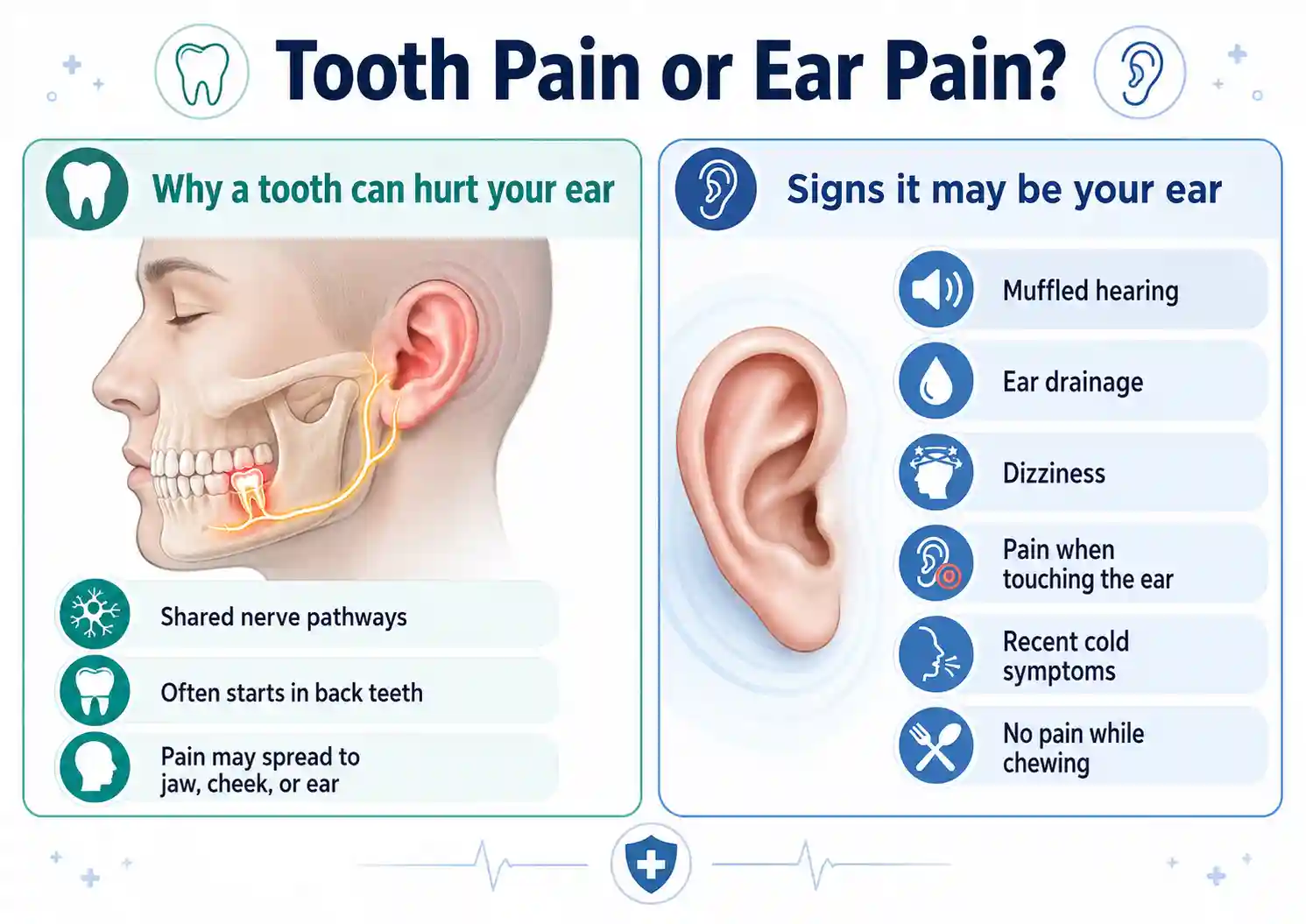
How Can Tooth Pain Cause Ear Pain?
The teeth, jaw, face, and ears are located close together and share several sensory nerve pathways. When a tooth becomes inflamed or infected, the brain may interpret some of the pain signals as coming from the ear.
This explains why a toothache can cause an earache even when there is nothing wrong inside the ear. The pain may feel dull, sharp, throbbing, or similar to pressure deep inside the ear.
Back teeth, particularly lower molars and wisdom teeth, are common sources of referred ear pain. Problems involving other teeth can also cause pain that spreads into the jaw, cheek, temple, ear, or neck.
Can Ear Pain Cause Tooth Pain?
An ear problem does not normally damage a tooth, but pain from the ear can sometimes feel as though it is coming from the teeth or jaw. This is another form of referred pain. An ear infection, pressure problem, or nearby inflammation may cause pain that spreads toward the jaw. Sinus inflammation can also create aching or pressure around the upper back teeth because their roots are located close to the sinus cavities.
Consider an ear or sinus cause when:
- Several upper teeth ache at the same time
- The discomfort began during or after a cold
- You have nasal congestion or facial pressure
- Your hearing feels muffled
- Fluid is draining from your ear
- You feel dizzy or unbalanced
- No individual tooth reacts to biting or temperature
Because the symptoms can overlap, you may need an examination from a dentist, doctor, or both.
How to Tell If Ear Pain Is Coming From a Tooth
It can be difficult to separate dental pain from an ear problem based on location alone. The symptoms accompanying the pain often provide the strongest clues.
Your ear pain may be coming from a tooth when:
One tooth feels particularly painful or sensitive
The pain worsens when you bite or chew
Hot, cold, or sweet foods trigger discomfort
You can see a cavity, crack, or damaged filling
The gum around a tooth is swollen or tender
You have a bad taste or unpleasant smell in your mouth
The pain spreads from your tooth into your jaw or ear
The pain becomes stronger when you lie down
Your face or jaw is swollen on the affected side
Dental pain does not always remain constant. It may come and go during the early stages of a problem and become more persistent as inflammation or infection progresses.
Signs the Pain May Be Coming From Your Ear
An ear condition may be more likely when the discomfort occurs with:
Muffled or reduced hearing
Fluid or pus draining from the ear
Itching inside the ear canal
Dizziness or balance problems
Recent cold or respiratory symptoms
Pain when pulling or touching the outside of the ear
A feeling of pressure that changes with altitude
No identifiable tooth sensitivity or pain while chewing
These signs are not a substitute for an examination. Some jaw and dental problems can also create ear pressure, ringing, or discomfort around the ear.
Dental Problems That Can Cause Ear Pain
Several oral health conditions can cause tooth and ear pain at the same time. The most likely cause depends on the location, severity, and triggers of the discomfort.
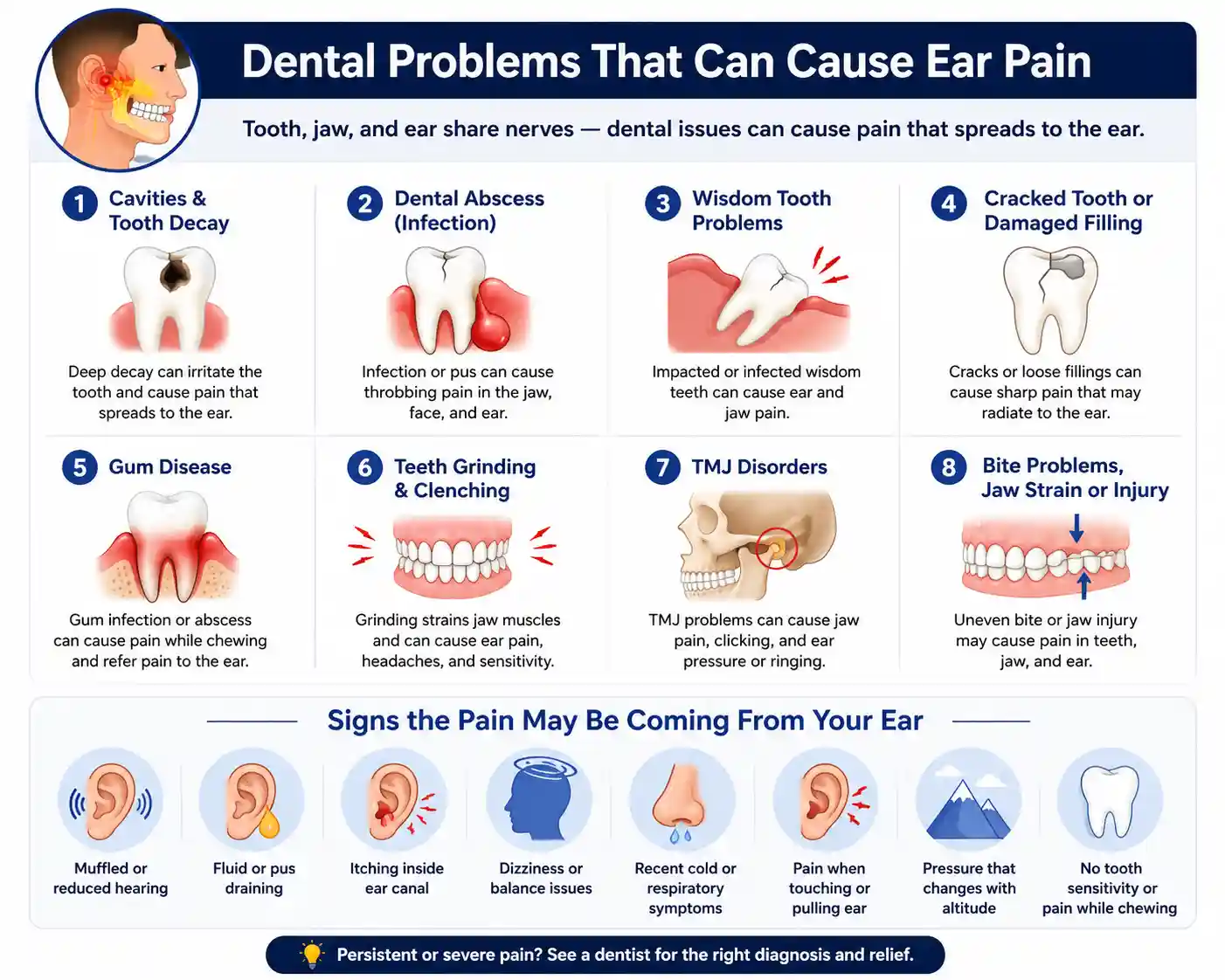
Tooth Decay and Cavities
A small cavity may not produce any symptoms. As tooth decay moves deeper into the tooth, it can irritate the sensitive tissue inside and cause a toothache. Advanced decay may cause pain when eating hot, cold, or sweet foods. The pain can also radiate toward the jaw or ear, especially when a back tooth is affected.
If you are wondering whether a cavity can cause ear pain, the answer is yes. However, ear pain is more likely when the decay has become deep enough to inflame or infect the tooth. A dentist may treat the tooth with a filling, crown, root canal, or another procedure based on how far the decay has progressed.
Dental Abscess or Tooth Infection
A dental abscess is a pocket of pus caused by a bacterial infection. It may develop inside a tooth, around the root, or in the gum tissue. An infected tooth can cause intense, throbbing pain that spreads into the ear, jaw, face, or neck. Other signs may include:
Swelling around the tooth or gum
Facial or jaw swelling
Sensitivity to heat or cold
Pain while biting
Fever
A bad taste in the mouth
Pus or fluid near the gum
Difficulty opening the mouth
A dental abscess does not normally heal without professional treatment. Depending on the location and severity, treatment may involve draining the infection, root canal treatment, gum treatment, or removing a tooth that cannot be saved.
Impacted or Infected Wisdom Teeth
Wisdom teeth may become trapped beneath the gums, emerge at an angle, or only partially erupt. Food and bacteria can collect around a partially erupted wisdom tooth and irritate or infect the surrounding gum.
Pain from a lower wisdom tooth may spread toward the ear because of its location near the back of the jaw. You may also notice gum swelling, jaw stiffness, an unpleasant taste, or difficulty opening your mouth.
Wisdom tooth pain should be examined rather than managed repeatedly with pain medication. A dentist can determine whether the area needs cleaning, infection treatment, monitoring, or tooth removal.
Cracked Tooth or Damaged Filling
A cracked tooth may cause sharp pain when biting or releasing pressure. It can also become sensitive to temperature changes. When a crack reaches the inner tooth tissue, the pain may become constant or spread toward the jaw and ear. Damaged or loose fillings can create similar symptoms by exposing sensitive parts of the tooth.
Not every crack is visible without dental equipment or an X-ray. Pain that repeatedly occurs while chewing should be checked even when the tooth looks normal.
Gum Disease
Early gum disease commonly causes redness, swelling, or bleeding. More advanced gum disease can damage the tissues and bone supporting the teeth. Severe gum inflammation or an abscess within the gum may cause pain while chewing, loose teeth, sensitivity, bad breath, and discomfort that spreads toward the jaw or ear.
Gum Disease Treatment depends on the severity of the condition. It may include professional cleaning, scaling and root planing, gum treatment, or management of an abscess.
Teeth Grinding and Clenching
Grinding or tightly clenching your teeth places pressure on the teeth, jaw muscles, and temporomandibular joints. Many people grind their teeth during sleep without realizing it.
Possible signs include:
Morning jaw soreness
Headaches after waking
Worn, flattened, or chipped teeth
Tooth sensitivity
Tight facial muscles
Pain around the ear
Jaw clicking or stiffness
A dentist can check for tooth wear and bite-related problems. Treatment may include behavior changes, stress management, a custom night guard, or care for damaged teeth.
Temporomandibular Joint Disorders
The temporomandibular joints connect the lower jaw to the skull and sit directly in front of the ears. Problems affecting these joints or the surrounding muscles can cause pain that feels like an earache or toothache.
TMJ-related symptoms may include:
Jaw pain or stiffness
Pain while chewing
Limited jaw movement
Painful clicking or popping
Facial or temple pain
Neck discomfort
Ear pressure or ringing
A change in how the teeth meet
A clicking jaw without pain does not always require treatment. Pain, locking, limited movement, or ongoing difficulty chewing should be professionally evaluated.
Bite Problems and Jaw Muscle Strain
An uneven bite may place extra pressure on certain teeth or jaw muscles. Dental work that feels too high, missing teeth, or changes in tooth position can also affect how the upper and lower teeth meet.
This pressure may produce tooth sensitivity, jaw fatigue, headaches, or pain near the ear. However, bite problems should not be assumed without an examination because similar symptoms can come from several other conditions.
Jaw or Dental Injuries
A fall, accident, sports injury, or blow to the face can damage the teeth, jawbone, jaw joint, or surrounding muscles.
Seek prompt care after an injury if you have:
A loose, broken, or displaced tooth
Difficulty bringing your teeth together
Severe jaw pain
Numbness in the face or lower lip
Bleeding that does not stop
Significant swelling
Difficulty opening or closing your mouth
Trauma-related ear and tooth pain may require both dental and medical assessment.
Can a Tooth Infection Cause Clogged Ears?
A tooth infection does not usually block the ear canal. However, inflammation and referred pain from a tooth, jaw muscle, or jaw joint may create a sensation of pressure or fullness around the ear.
This can make the ear feel clogged even though there is no physical obstruction inside it.
Persistent ear blockage may instead come from earwax, fluid behind the eardrum, an ear infection, sinus congestion, or Eustachian tube dysfunction. Seek a medical evaluation when ear fullness occurs with noticeable hearing loss, drainage, dizziness, fever, or no clear dental symptoms.
Why Is My Toothache Making My Ear Hurt?
A toothache may make your ear hurt because the brain receives pain signals from nearby areas through connected nerve pathways. It may have difficulty identifying whether the original signal came from the tooth, jaw, or ear.
This is especially common when pain starts in a back molar, wisdom tooth, jaw muscle, or temporomandibular joint. The discomfort may feel as though it travels directly from the tooth toward the ear.
The location of the pain does not show how serious the dental problem is. A mild earache can still come from significant tooth decay or infection, while severe pain may sometimes come from muscle tension or jaw inflammation.
What Does Tooth Pain Radiating to the Ear and Neck Mean?
Tooth pain radiating to the ear and neck may come from severe tooth inflammation, an abscess, an impacted wisdom tooth, TMJ dysfunction, or strained jaw muscles.
Dental infection becomes a greater concern when radiating pain occurs with:
- Facial or neck swelling
- Fever
- Swollen glands
- Pus or a bad taste
- Difficulty chewing
- Difficulty opening the mouth
- Increasing pain that does not settle
Pain extending into the neck does not automatically mean an infection is spreading. However, worsening swelling, fever, or problems swallowing require urgent attention.
Should You See a Dentist or a Doctor?
See a dentist first when the pain is linked to a specific tooth or triggered by biting, chewing, hot food, cold drinks, or sweets. Visible tooth damage, gum swelling, a bad taste, or facial swelling also suggests that a dental examination is appropriate.
See a doctor when the symptoms include:
Hearing loss
Ear drainage
Dizziness
Recent cold or flu symptoms
Persistent nasal congestion
Pain when touching the outer ear
No tooth sensitivity or pain while biting
Start with whichever professional is most appropriate based on your strongest symptoms. If the first examination does not identify the cause, further dental, medical, or ear, nose, and throat evaluation may be recommended.
How a Dentist Identifies the Source of Tooth and Ear Pain
A dentist will ask when the pain started, where it is felt, what triggers it, and whether it spreads to another area.
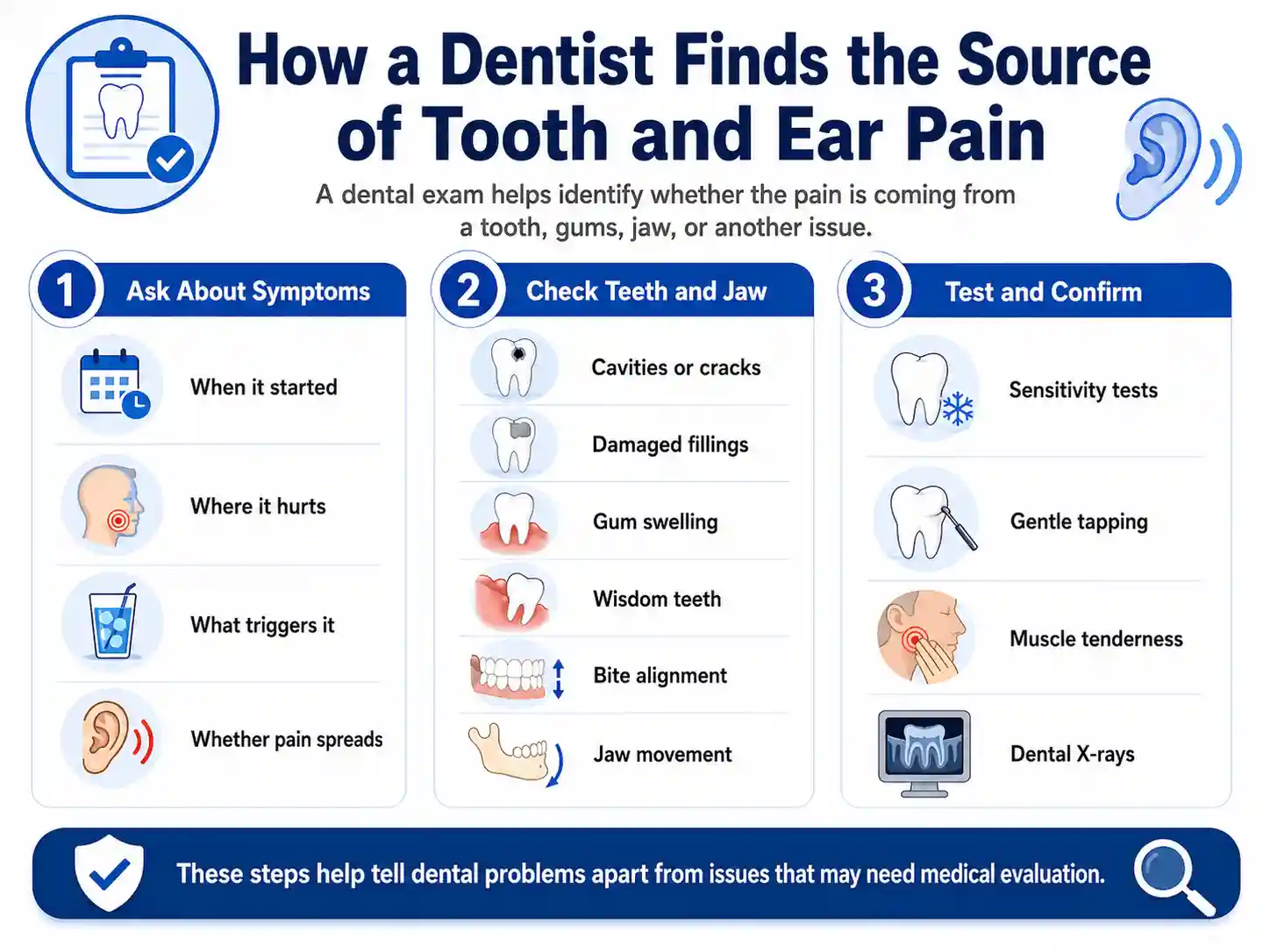
A dentist will ask when the pain started, where it is felt, what triggers it, and whether it spreads to another area.
The examination may include:
Checking for cavities, cracks, and damaged fillings
Looking for gum swelling or infection
Testing individual teeth for sensitivity
Applying gentle pressure or tapping the teeth
Examining the wisdom teeth
Checking how the teeth meet
Evaluating jaw movement and muscle tenderness
Taking dental X-rays when needed
These steps help separate tooth decay, infection, gum disease, cracked teeth, and jaw disorders from conditions that may need medical evaluation.
How Is Tooth-Related Ear Pain Treated?
Treatment depends on what is causing the pain. Ear discomfort should improve after the underlying dental or jaw problem is properly managed.
Possible treatments include:
- A filling for a cavity
- A crown for a weakened or damaged tooth
- Root canal treatment for infected inner tooth tissue
- Tooth extraction when a tooth cannot be saved
- Professional gum treatment
- Treatment for an abscess
- Care for an impacted wisdom tooth
- Repair or replacement of a damaged filling
- A night guard for grinding or clenching
- Conservative treatment for a jaw disorder
Antibiotics are not the correct treatment for every toothache. They may be prescribed when there are signs that a bacterial infection is spreading or affecting the body, but the dental source usually still requires direct treatment.
What Can You Do Until Your Appointment?
Temporary measures may make the discomfort easier to manage, but they will not repair a cavity, cracked tooth, or dental infection.
Until you receive professional care:
Rinse gently with warm salt water
Keep the area clean with careful brushing and flossing
Eat softer foods
Chew on the opposite side
Avoid very hot, cold, or sugary foods
Use an over-the-counter pain reliever only as directed
Place a cold compress against the outside of the face if swelling is present
Do not place aspirin directly against the tooth or gum. It can irritate or damage the soft tissue. Do not delay an examination simply because the pain temporarily improves. Dental pain can decrease when the nerve inside a tooth becomes badly damaged, even though the infection remains.
When Is Tooth and Ear Pain an Emergency?
Contact a dentist promptly for severe tooth pain, facial swelling, fever, pus, a bad taste, or difficulty opening your mouth.
Seek emergency medical care when swelling in the mouth, face, or neck:
Makes it difficult to breathe
Makes it difficult to swallow or speak
Spreads toward the eye
Increases rapidly
Is accompanied by severe weakness or confusion
These symptoms may indicate a serious infection that requires immediate assessment.
Conclusion
Your tooth may be causing your ear pain when the discomfort is on the same side as a painful tooth and becomes worse while chewing, biting, or pressing on that tooth. Other clues include sensitivity to heat or cold, swollen or tender gums, jaw pain, bad breath, an unpleasant taste, or visible damage to a tooth. A dental abscess can cause constant or throbbing pain that spreads into the ear, jaw, or neck.
Ear pain is more likely to begin in the ear when it occurs with hearing changes, fluid drainage, congestion, cold symptoms, or a feeling of fullness inside the ear. Pain around both the ear and jaw may also come from TMJ problems, while facial pressure and pain in several upper teeth may be associated with sinusitis.
You cannot always confirm the source of the pain from symptoms alone. Schedule a dental examination if the pain appears connected to a tooth, lasts longer than a day or two, or keeps returning. Seek urgent care for facial or neck swelling, fever, difficulty swallowing, difficulty breathing, or rapidly worsening pain, as these can indicate a spreading dental infection.
Get Tooth and Ear Pain Properly Evaluated
Tooth and ear pain can feel closely connected, but the location of the discomfort does not always reveal where it started. Cavities, infections, wisdom teeth, teeth grinding, and jaw disorders can all produce pain around the ear.
A proper examination can identify whether the pain begins in a tooth, the jaw joint, or the ear. Contact U Smile Family Dentistry to schedule a Consultation if you have ongoing tooth sensitivity, pain while chewing, gum swelling, or an earache that may be connected to a dental problem.
FAQs
How can I tell if my ear pain is coming from a tooth?
Ear pain is more likely to be dental when you can identify a sensitive or painful tooth and the discomfort worsens with chewing, biting, or hot and cold foods. Gum swelling, a visible cavity, a cracked tooth, or a bad taste also suggests a dental cause.
Which teeth are most likely to cause ear pain?
Back molars and wisdom teeth are common sources because they are located near the jaw joint and surrounding nerves. However, decay, cracks, or infection in other teeth can also produce referred ear pain.
Can a tooth infection make my ear feel blocked?
A tooth infection may create pressure or discomfort that feels like ear fullness, but it does not normally block the ear canal. Muffled hearing, drainage, dizziness, or persistent blockage should be evaluated for an ear condition.
Can an ear infection feel like a toothache?
Yes. Pain from an ear problem may sometimes be felt in the jaw or teeth because the areas have overlapping nerve pathways. An examination may be necessary when the source of the pain is unclear.
Can an impacted wisdom tooth cause ear and neck pain?
An impacted or infected wisdom tooth can cause pain around the back of the jaw that radiates toward the ear or neck. Swelling, difficulty opening the mouth, an unpleasant taste, or fever requires prompt dental attention.
Should I see a dentist or doctor for tooth and ear pain?
Start with a dentist when the pain is linked to a specific tooth, biting, chewing, temperature sensitivity, or gum swelling. See a doctor when you have hearing changes, ear drainage, dizziness, recent respiratory symptoms, or no identifiable dental symptoms.
When is tooth and ear pain an emergency?
Seek urgent care for rapidly increasing facial or neck swelling, difficulty breathing or swallowing, swelling near the eye, severe illness, or an inability to open your mouth normally. These symptoms may indicate a spreading infection.
Will ear pain stop after the damaged tooth is treated?
Ear pain caused by a dental problem should improve once the underlying tooth inflammation or infection is treated. Persistent pain after dental treatment may require further dental evaluation or an examination of the ear, jaw joint, sinuses, or facial nerves.